Homes in the Winter Park Pines area run their AC for nine or ten months straight. That kind of continuous use does something to a duct system that shorter seasons simply don't. Debris builds faster. Central Florida's humidity creates conditions for biological growth inside the ductwork, and the filter only catches what passes through the air handler. Everything else settles into the ducts over time.
Winter Park, FL carries a lot of 1980s and 1990s housing, particularly in the Pines corridor and along Howell Branch Road. That era of construction leaned heavily on flex duct systems, which perform well when they're new but develop sags and low points as they age. Those low points collect whatever settles out of the airstream. Across our inspection calls throughout Orange County, duct systems in homes built before 2000 consistently show the heaviest contamination at those bends and junctions. Air duct cleaning in Winter Park addresses what that combination of housing stock and climate actually produces — not a national average, but what we find in these specific homes on these specific duct configurations.
TL;DR Quick Answers
How Do You Tell If Air Ducts Need Cleaning in Winter Park, FL?
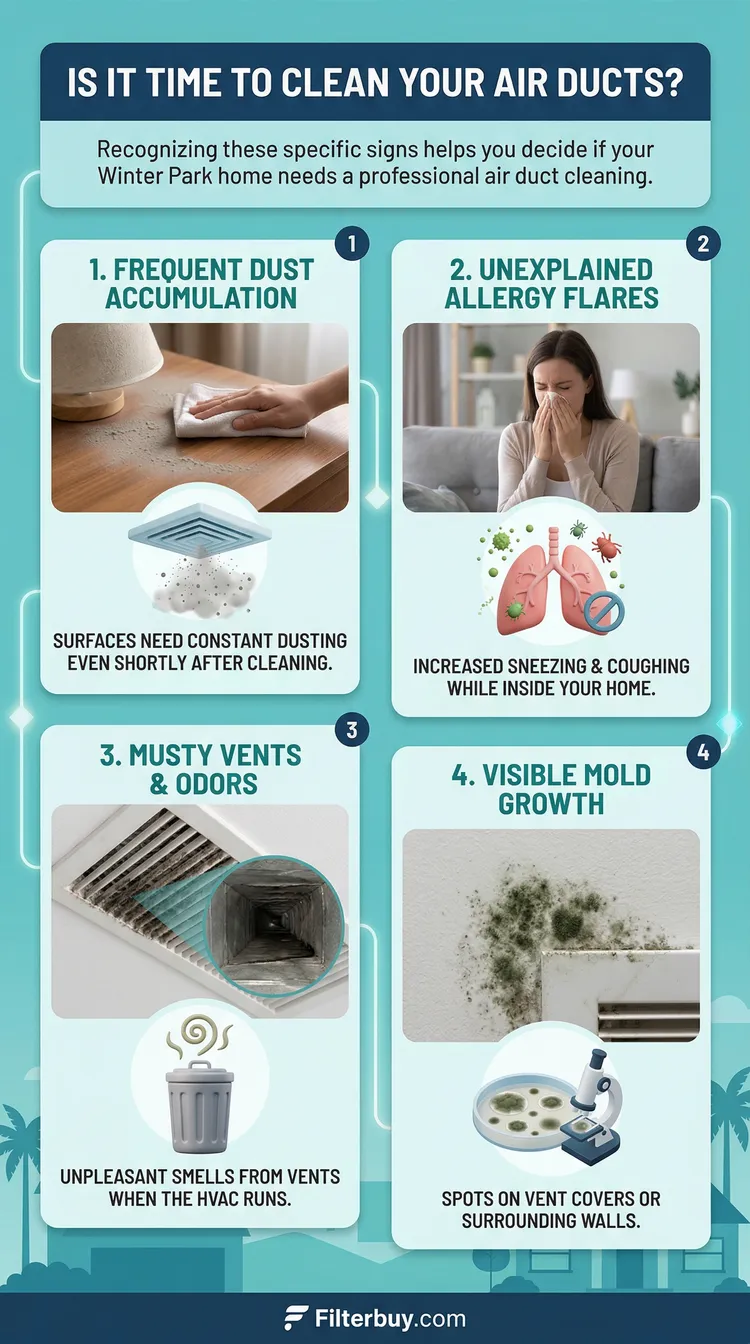
The most reliable signs are dust that returns quickly after wiping down registers, musty or stale odors when the AC runs, indoor allergy symptoms that are worse than outdoor exposure during pollen season, and uneven airflow between rooms. Winter Park homes, especially those built in the 1980s and 1990s with flex https://www.hepaairfilterforhome.com/boosting-hepa-filter-efficiency-with-professional-air-duct-cleaning-service-in-pinecrest-fl, tend to accumulate debris at duct bends where airflow slows, and things settle. NADCA recommends professional cleaning every three to five years. Florida's near-year-round AC use makes three years the practical benchmark for most homes in this area.
Top Takeaways
Dust that comes back within a day or two of wiping down a register points to the duct system as the source, not just ambient room dust.
Musty or stale odors during AC cycles often point to mold or mildew inside the ductwork, which we find regularly in Florida homes with aging duct insulation or aging air handler components.
Homes built before 2000 in Winter Park frequently have flex duct configurations that collect debris at bends and low points faster than more recent duct layouts.
If indoor allergy symptoms are measurably worse than outdoor exposure during Orange County's pollen season, and your filter is on schedule, dirty ducts recirculating accumulated allergens are a likely factor.
NADCA recommends cleaning every three to five years. Florida's extended AC season and year-round humidity push most local homes toward the shorter end of that window.
Visible Dust Around Vents and Registers
A thin layer of dust on a register is normal, especially in homes with pets or near well-traveled roads. What you're watching for is a heavy coating that comes back within a day or two of wiping it down. When that happens, the register isn't the source. The duct system behind it is. In Winter Park homes with tile or hardwood floors, this pattern shows up most clearly around ceiling registers in main hallways and living areas.
Musty or Stale Odors When the AC Runs
Central Florida's humidity is the primary driver here. When moisture enters a duct system — through a small leak, degraded attic duct insulation, or an aging air handler — mold and mildew follow. The smell starts faint and tends to hit hardest in the first few minutes of an AC cycle, when the initial airflow pushes through the affected section. If you've already checked the air handler's condensate drain and the odor keeps returning, the ductwork itself warrants a professional look.
Worsening Allergy Symptoms Indoors
Orange County carries a heavy pollen load from late winter through spring, with oak, maple, and pine all contributing. A clean duct system won't stop pollen from entering your home, but a dirty one recirculates what's already been drawn in. We've found, across service calls in this area, that households with allergy-prone occupants report clear improvement after a professional duct cleaning. If symptoms are measurably worse inside than outside during pollen season and your filter schedule is current, the ductwork deserves attention.
Uneven Airflow Between Rooms
One bedroom runs noticeably cooler than the one beside it. Another room never quite reaches the temperature on the thermostat. Debris buildup inside long duct runs restricts airflow in ways that a new filter or thermostat adjustment won't fix. This pattern is especially common in two-story Winter Park homes, where upstairs runs are longer and accumulate more resistance over time.
Your Ducts Haven't Been Cleaned in More Than Five Years
NADCA recommends professional cleaning every three to five years. In Florida, with near-continuous AC use and persistent seasonal humidity, three years is the more practical target for most homes. If you moved in without records from the previous owner, treat it as overdue. That's the same advice we'd give a neighbor in the same situation.
"In the Central Florida homes we work in, dirty ducts rarely look dramatic. They quietly cut airflow and air quality over months — sometimes longer — until something finally makes the homeowner take notice. The tell is almost always the same: debris concentrated at duct bends and near the air handler, where airflow slows and things settle. An inspection takes the guesswork out of the whole thing."
Essential Resources
1. EPA: Introduction to Indoor Air Quality — The EPA's foundational resource on indoor pollutants, sources, and health effects.
2. NADCA: What Is Duct Cleaning? — The National Air Duct Cleaners Association's standard for professional duct cleaning and what homeowners should expect from a legitimate service call.
3. EPA: Should You Have the Air Ducts in Your Home Cleaned? — A direct EPA guide that helps homeowners weigh the decision without bias toward any service provider.
4. ENERGY STAR: Duct Sealing and Insulation — ENERGY STAR guidance on duct efficiency, air loss, and energy impact.
5. Florida DBPR — Verify a Contractor License — Look up any licensed HVAC contractor in Florida before scheduling work.
6. CDC: Indoor Environmental Quality — CDC resources on indoor air contaminants applicable to residential environments.
Supporting Statistics
The EPA reports that Americans spend approximately 90 percent of their time indoors, which makes indoor air quality a more direct daily health variable than outdoor air for most people.
Source: EPA — Indoor Air Quality
The EPA has found that indoor air can be two to five times more polluted than outdoor air and, in certain conditions, more than 100 times — a figure that reflects how dust, biological contaminants, and combustion byproducts concentrate inside sealed, recirculating systems.
Source: EPA — Introduction to Indoor Air Quality
ENERGY STAR estimates that in a typical home, about 20 to 30 percent of the air moving through the duct system is lost due to leaks, gaps, and poorly connected sections — a loss that compounds the longer a system runs without maintenance, which in Florida means most of the calendar year.
Source: ENERGY STAR — Ducts
Final Thoughts and Opinion
The rationalization pattern we hear most often goes something like this: you wipe down the dusty vent, chalk the faint smell up to Florida weather, and put a box fan in the room that won't cool. Each one, handled in isolation, feels manageable. Together, they're usually telling you something that a filter change or thermostat adjustment won't fix.
In our experience across Orange County service calls, homeowners who wait the longest are almost always the ones who weren't sure the problem was serious enough to call about. When two or more of the signs above show up at the same time, that combination is a reliable signal worth acting on. At that point, an inspection makes sense regardless of when the system was last serviced.
We tell homeowners exactly what we find. A clean inspection means you walk away with confirmation, not a service order. When the system needs work, we show you what we found before anything gets scheduled.
Frequently Asked Questions
1. How do I know if my air ducts actually need cleaning, or if I just need a new filter?
A new filter addresses what enters the system going forward, but it doesn't clean what's already built up inside the ductwork. If you're changing filters on schedule and still seeing persistent dust around registers, uneven airflow, or recurring odors, those signs point to the duct system itself rather than the filter slot.
2. How often should air ducts be cleaned in Winter Park, FL?
NADCA's standard is every three to five years. In Winter Park, where AC systems run the better part of the year and humidity accelerates biological growth inside ducts, three years is a more practical target for most homes — particularly those built before 2000 or those with pets and occupants with respiratory sensitivities.
3. Does air duct cleaning actually improve energy efficiency?
It can, depending on how restricted the system was to begin with. Debris buildup inside long duct runs forces the system to work harder to move the same volume of conditioned air. Restoring airflow helps the system run closer to its rated capacity. Homeowners in older Winter Park homes with long duct runs often notice a difference in how consistently rooms reach their target temperature.
4. Can I inspect my own air ducts before calling anyone?
You can do a reasonable preliminary check. Remove a few vent covers and shine a flashlight into the duct opening — look for visible dust accumulation, debris, or any dark spotting that might indicate mold. You won't be able to see deep into the duct runs or assess the condition of the air handler coil, which is where contamination tends to be worst. A professional inspection covers the full system, including sections no homeowner can reach without equipment.
5. Do you also clean dryer vents, or only HVAC ducts?
We handle dryer vent cleaning as well. The two services address different systems and different risks — lint accumulation in a dryer vent is a fire hazard, not an air quality issue — but many homeowners schedule both at the same time since the work happens in similar areas of the home. If you're already having your HVAC ducts inspected, it makes sense to have the dryer vent checked during the same visit.
Ready for a Closer Look?
A quick inspection tells you what you actually need to know. We make it easy to schedule at a time that works, and there's no pressure attached. We walk through what we find, explain what it means, and let you decide what makes sense for your home.
Our team covers Winter Park and the broader Orange County area. Book online or reach us by phone — we're your neighbors out here too.
Here is the nearest branch location serving the Winter Park area. . .
Filterbuy HVAC Solutions
2900 Titan Row # 128, Orlando, FL 32809
(407) 204-1859
https://maps.app.goo.gl/Weuf8AhtuRP4H855A